 A study published in the journal Nature today suggests that Stem Cell therapy could be used to improve hearing. The study was conducted on Gerbils, due to their similar hearing range, and after 10 weeks the group of 18 had regained on average 46% of their hearing, with a control group of 8 Gerbils not regaining any hearing without the therapy. The therapy involved administering a drug to the Gerbils which caused deafness by damaging the auditory nerves. Using human embryonic stem cells, they injected about 50,000 early stage auditory neurones into the cochlea. Although not resulting in an overall cure for deafness, the Gerbils went from not being able to hear busy traffic to being able to hear conversations - suggesting that it could result in a return to normality if tried on Humans. However, the ultimate aim would be to use these neurones, adding sensory hairs, alongside a cochlear implant. Although Human trials are still several years away, this breakthrough is encouraging news for the 10 million deaf people in the United Kingdom, 15% of whom could be cured by this exact procedure should it work in humans.
Wednesday, 12 September 2012
Stem Cells as a Cure for Deafness
A study published in the journal Nature today suggests that Stem Cell therapy could be used to improve hearing. The study was conducted on Gerbils, due to their similar hearing range, and after 10 weeks the group of 18 had regained on average 46% of their hearing, with a control group of 8 Gerbils not regaining any hearing without the therapy. The therapy involved administering a drug to the Gerbils which caused deafness by damaging the auditory nerves. Using human embryonic stem cells, they injected about 50,000 early stage auditory neurones into the cochlea. Although not resulting in an overall cure for deafness, the Gerbils went from not being able to hear busy traffic to being able to hear conversations - suggesting that it could result in a return to normality if tried on Humans. However, the ultimate aim would be to use these neurones, adding sensory hairs, alongside a cochlear implant. Although Human trials are still several years away, this breakthrough is encouraging news for the 10 million deaf people in the United Kingdom, 15% of whom could be cured by this exact procedure should it work in humans.

Tuesday, 11 September 2012
Hay Fever Vaccine
 Research conducted by Imperial College London and King's College London has suggested that a new Hay Fever vaccine could be developed as a cure for the sufferers. This is great news for those who do suffer from Hay Fever, the number of them exceeding 10 million in England alone, with the current vaccine only benefiting about 1,000 people. The main treatment is in the form of drugs including antihistamines and steroids, with injections of pollen under the skin being reserved for the serious cases due to the expensive nature of the treatment. The research team endeavoured to use shallowed injections in an area of the skin which is densely packed with white blood cells, allowing them to use a dose which is 1/2000th of the current injection. In the test group of 30 patients, it was suggested that the allergic reaction to grass pollen decreased because of the vaccine. A clinical trial with 90 patients is now commencing in order to find if the vaccine can combat symptoms other than grass allergy including sneezing. The relatively small dosage and the fact that fewer injections need to be administered per patient makes this method of treatment a lot more cost effective than previous attempts, and with Allergy UK describing this breakthrough as very encouraging, there is a strong possibility that within the next few years suffering from hay fever will be a thing of the past.
Wednesday, 5 September 2012
Use found for "junk" DNA
 Researchers have gained an understanding into the purpose of the long stretches of DNA, previously dismissed as "junk." Our understanding was that genes were the only important parts of the DNA molecule despite them only accounting for 2% of DNA. A new use has been discovered for another 80%. Within these regions, more than 10,000 new genes which code for how we control the genes that we know code for proteins and are thought to be Regulatory elements. One of the researchers, Professor Mike Snyder said "Much of the difference between people is due to the differences in the efficiency of these regulatory elements. There are more variants, we think, in the regulatory elements than in the genes themselves." The regulatory elements are thought to turn genes on or off and their discovery will provide an entirely new avenue for scientists to explore when seeking treatments for known conditions including Heart Disease and Diabetes. This is because genes are unable to function without regulatory elements, with malfunctioning of genes occurring when regulation fails, resulting in diseases including cancer and atherosclerosis. For now, 9% of DNA was found to be involved in the coding for regulatory switches although the true figure is thought to be closer to 20%.
Tuesday, 4 September 2012
Frozen IVF Embryos Debate
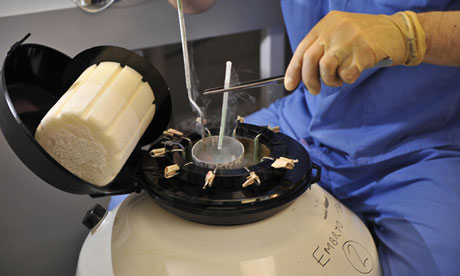
However, on the other hand, data from the Human Fertilisation and Embryology Authority shows that as of 2010, the success rate for frozen embryos was 23% compared to 33% for freshly implanted embryos.
It is unknown why such results are produced and they have been described as "counter-intuitive" by the lead researcher Dr. Abha Maheshwari. There are several theories which include one that states that the previously frozen embryos are given after the women's ovaries had settled down from the hormone treatment used to stimulate the ovaries so the hormone levels in the womb had returned to a more normal level and the embryos had been implanted into a more natural environment. Another idea is that only the high quality embryos are able to survive the whole process of being frozen although, with new developed methods, the survival rate tends to be more than 90%. The findings, although not acknowledged as experimentally sound by everyone, raise the question whether it would be wise to freeze all embryos before implanting them, a practice which is currently adopted in Japan. Their reviews say that previously frozen IVF embryos had 50% less of a chance of being born too small and 16% less risk of being preterm compared to fresh embryo babies The findings suggest that it would be safer for both the mother - suffering less bleeding - and the baby who would be less likely to have any complications. Although a long way off being confirmed and facing a lot of opposition, a debate in the near future once more experiments have been conducted is likely and there remains a possibility that the system currently run in IVF treatment might change in light of these findings.
Subscribe to:
Comments (Atom)